Abstract
Multi-agent systems (MAS) based on large language models (LLMs) have become a powerful way to address complex problems, and their effectiveness depends critically on the collaboration topology that decides which agents participate and how they communicate. Recent work learns to generate this topology from the task query, fitting the generator to corpora of execution-verified graphs. The post-training method for such generators remains a limitation: a corpus lists the graphs that solved a query but never ranks them, leaving continued supervised fine-tuning (SFT) with no per-query preference to exploit. Without such a preference, the generator drifts toward the topologies the corpus contains most often rather than those that suit each query, so a gain on one task can come at a cost on another.
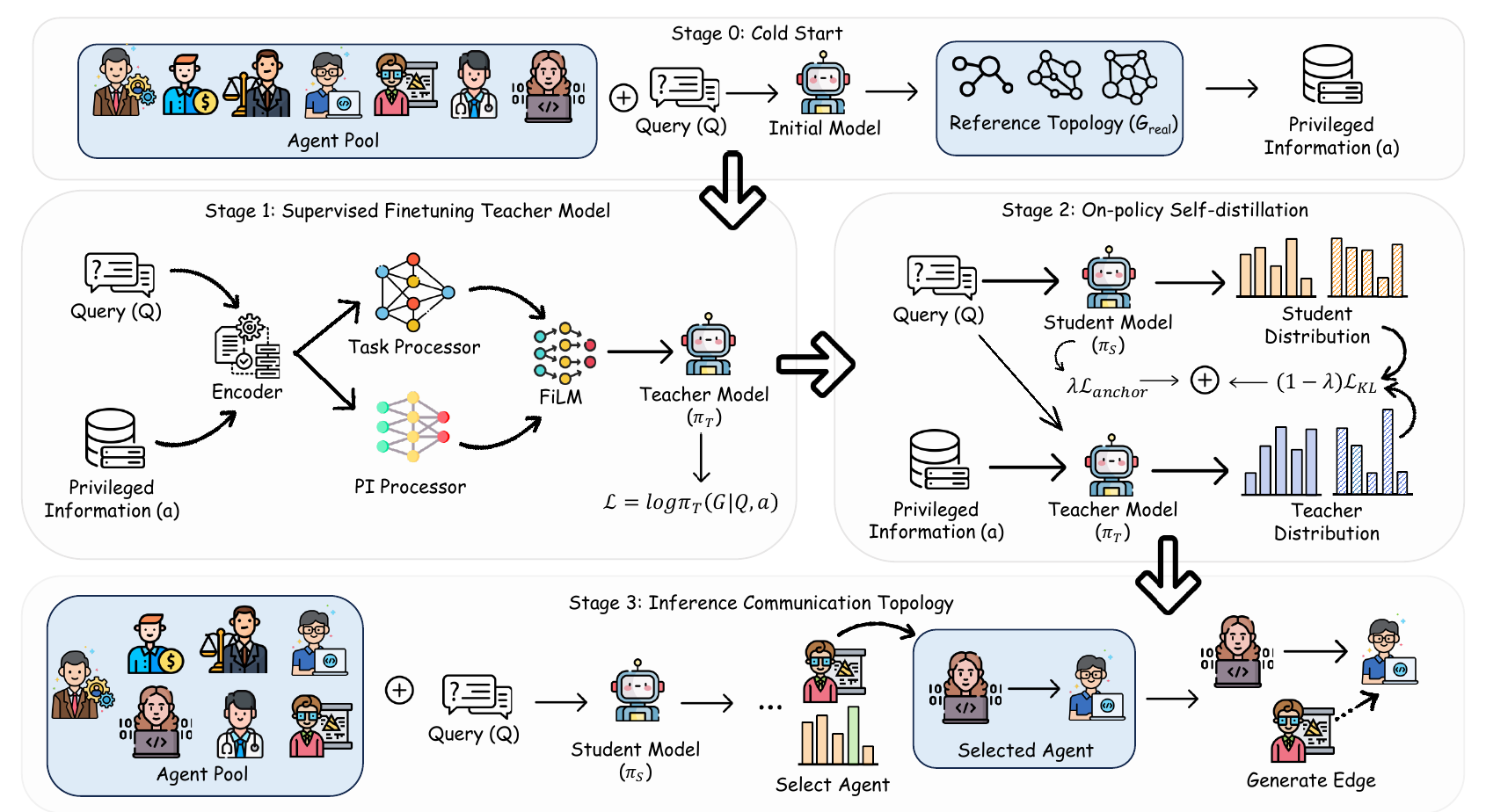
We propose PRISM, which recovers per-query signal from the same corpus by learning with privileged information: a teacher reads, through a zero-initialized low-rank branch, a sibling graph that also solved the query and is unavailable at deployment, and the student matches its per-decision targets on trajectories the student samples itself. Across six diverse benchmarks PRISM improves over every topology-design baseline evaluated, and matched-teacher controls support the contribution of privileged query information.
Motivation
A verified corpus says which graphs worked, but never which one is best. How do we post-train on it?
(a) Continued SFT
- Fits the recorded graphs by teacher forcing, with no per-query preference among the several graphs that solved each query.
- Concentrates the output distribution: the top-1 topology share doubles from 0.171 to 0.346.
- Gains are uneven: +6.15 on GSM8K, but −12.60 on AQuA relative to ARG-Designer.
- Supervises only recorded trajectories, so partial graphs the student reaches on its own get no supervision (exposure bias).
(b) PRISM
- A teacher sees a sibling graph (another verified topology for the same query) as training-only privileged information.
- The student samples its own graphs, and the teacher scores every node and edge decision on those student-visited partial graphs.
- A supervised anchor keeps the student close to valid verified topologies.
- Reuses the same corpus: no new MAS executions, and the deployed model is architecturally identical to ARG-Designer.
Method
MAS as a collaboration graph. Following ARG-Designer, a MAS is a directed acyclic graph \(G=(V,E)\) whose nodes are LLM agents with roles from an extensible pool \(\mathcal{R}\). An edge \(e_{ji}\) feeds agent \(v_j\)'s output into \(v_i\)'s prompt. The designer generates the graph autoregressively, one role and then its incoming edges at a time:
The verified corpus \(\mathcal{D}\) holds every blueprint graph (chain, star, layered, fully-connected, mesh) that solved a training query. A query is typically solved by several distinct topologies, and none of them is marked as preferable.
Fit the designer on verified graphs
ARG-Designer is trained on execution-verified query–graph pairs, giving the deployed checkpoint \(\theta_0\). The same corpus later supplies the privileged sibling graphs.
A clone that reads a sibling graph
The teacher is a copy of \(\theta_0\) whose conditioning vector is FiLM-modulated by a rank-16 encoding of a sibling graph \(a\):
The FiLM output is zero-initialized, so the teacher starts identical to the student. The sibling is drawn uniformly from the other verified graphs for the same query and resampled every epoch. The channel adds about 20k parameters.
Correct the student where it actually goes
The student samples \(M=4\) complete topologies per query. The frozen teacher (with \(a\)) and the student (without \(a\)) rescore them. Their node and edge decision spaces are small and categorical, so the divergence is computed exactly:
Defaults are \(\alpha=0.2\), \(\lambda=0.3\) and reverse KL. Setting \(\lambda=1\) recovers the SFT control.
Student only, query only
The teacher and its privileged channel are discarded. The deployed student is architecturally identical to ARG-Designer: it selects agents and generates edges from the query alone. At \(K=1\) it uses 4.04 LLM calls per query, against 4.00 for ARG-Designer.
Benchmark Results
Controls and ablations
Why Does It Work?
The teacher reads the channel
On held-out graphs we score the same teacher with the channel on and off, \(\Delta=\log P_{\text{teacher}}(G\mid Q,a)-\log P_{\text{teacher}}(G\mid Q)\). A shuffle control matches the channel, parameter count and budget, but shows each query another query's graph.
The shuffled FiLM branch does train (its norm rises from zero), yet its gain never leaves zero. The real channel's +2.45 nats therefore comes from what the channel carries, not from extra capacity.
Content, not just procedure
A constant teacher keeps on-policy distillation but holds the privileged input fixed. Separating the two effects on AQuA:
Across all six benchmarks, PRISM beats the constant teacher (+1.66 on average, sign test \(p=0.031\)) under matched epochs, sampling, supervision, loss mixture and compute. The shuffled teacher is worse than constant on all six, so another query's graph actively misleads the student.
Less concentration, more query dependence
SFT collapses onto a default crew
SFT's most frequent role assignment, [Math Solver, Programming Expert, Programming Expert], appears on roughly a third of questions on every math benchmark. PRISM lowers the top-1 topology share to 0.157. The query explains 5.8% of PRISM's output entropy (above a permutation null), against 2.0% for SFT.
Concentration is not a loss of vocabulary: the cold start emits 22 distinct shapes, SFT 40 and PRISM 34.
Difficulty-matched control
Questions are split by whether SFT emitted its default crew, and both arms are scored on exactly the same questions. On AQuA, PRISM improves in both groups, so the default crew explains part of the gap but not all of it.
| Benchmark | Group | n | SFT | PRISM | Δ | McNemar p |
|---|---|---|---|---|---|---|
| GSM8K | SFT emitted default | 460 | 87.4 | 88.5 | +1.1 | 0.68 |
| SFT emitted other | 859 | 85.4 | 87.8 | +2.4 | 0.15 | |
| SVAMP | SFT emitted default | 371 | 91.6 | 94.6 | +3.0 | 0.16 |
| SFT emitted other | 629 | 92.8 | 92.5 | −0.3 | 0.92 | |
| AQuA | SFT emitted default | 91 | 60.4 | 79.1 | +18.7 | 0.0001 |
| SFT emitted other | 163 | 63.8 | 74.8 | +11.0 | 0.003 |
Qualitative Examples
The crew each designer builds on GSM8K problems (Qwen2.5-7B-Instruct), and the answer the resulting system returns.
BibTeX
@article{dat2026prism,
  title={PRISM: PRIvileged Sibling-Guided Multi-Agent Topology Design},
  author={Dat, Phuong Tuan and Li, Qi and Wang, Xinchao},
  journal={arXiv preprint arXiv:2610.20628},
  year={2026}
}